The simulation exercise Tamlar 2.0 invites participants to co-create climate change adaptation. It brings together a diverse range of actors from the fictional Tamlar mountain region — including local authorities, farmers, hydropower companies, researchers, and civil society groups — and engages them in two stakeholder workshops to negotiate the implementation of a transboundary climate adaptation project.
At the heart of the exercise are different perspectives, interests, and priorities. Participants develop innovative solutions that combine compromise and cooperation in order to address climate change and its impacts in the mountain region. The simulation exercise makes the complexity of regional governance, the dynamics of decision-making processes, and the need for cross-border collaboration tangible, while encouraging a reflective approach to risk, climate change, and cooperation in mountain contexts.
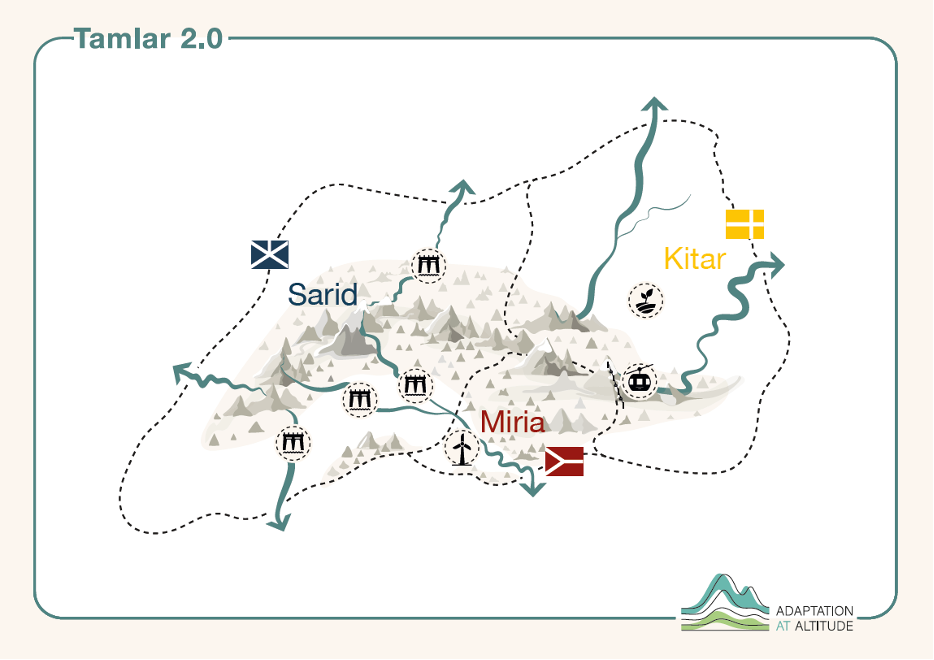
The fictive Tamlar Mountains span the borders of Sarid, Kitar, and Miria, forming a high-altitude region characterised by fragile ecosystems, rich biodiversity, and critical water resources for the entire area. The three countries have different priorities: Sarid, the largest, focuses on expanding hydropower infrastructure; Miria, a downstream country, is characterised by strong community cohesion and engagement; and Kitar has weaker ties to mountain communities and a strong interest in developing tourism.

Eight stakeholders from the fictive Tamlar Mountain Range participate in the stakeholder consultation meetings, representing government, research, business, and local community perspectives across Sarid, Kitar, and Miria.
Materials provided
- Participant guide [→ download]
- Facilitator guide [→ download]
- Role cards [→ download]
- Tamlar 2.0 context information [→ download]
- Map of the Tamlar Mountain Range [→ download]
- Name tags [→ download]
- Incident cards [→ download]
The Tamlar 2.0 materials may be further used and adapted for non-commercial purposes. Users are requested to acknowledge the Adaptation at Altitude programme and provide appropriate credit when using or modifying the materials.
Imprint
Tamlar 2.0 – A Simulation Exercise for Regional Mountain Range Governance was developed in the context of the second Mountains Connect workshop, organized by ICIMOD and UNEP as part of the Adaptation at Altitude. Concept and design by Zoï Environment Network.
Launched and supported by the Swiss Agency for Development and Cooperation, Adaptation at Altitude is a collaborative programme dedicated to increasing the resilience of mountain communities and ecosystems to climate change. It aims to improve the availability and use of data and knowledge, strengthen science-policy platforms and dialogues, and build capacity and resource mobilisation for the evidence-informed formulation and implementation of effective climate change adaptation policies and institutional measures at the national, regional, and global levels.
Tamlar 2.0 is inspired by the Tamlar Range Governance Simulation (Version 1.0), developed by Jörg Balsiger and Stéphanie Reusse (2022) from the University of Geneva, and was developed to help workshop participants explore and understand the perspectives, priorities, and needs of different stakeholders in a transboundary mountain range project.
Author:
Johanna Zwahlen (Zoï Environment Network)
Contributors:
Alex Mackey (Zoï Environment Network), Ansgar Fellendorf (UNEP) and Mariam Devidze (UNEP)
Graphic design:
Carolyne Daniel (Zoï Environment Network)
Financial support:
Swiss Agency for Development and Cooperation
April 2026